Sykesville’s Black Heritage Project: An Interview with Owen “Hanky” Norris
by Megan Forbes (with sketchnote by Wade Forbes)
How long have you or your family been part of this community?
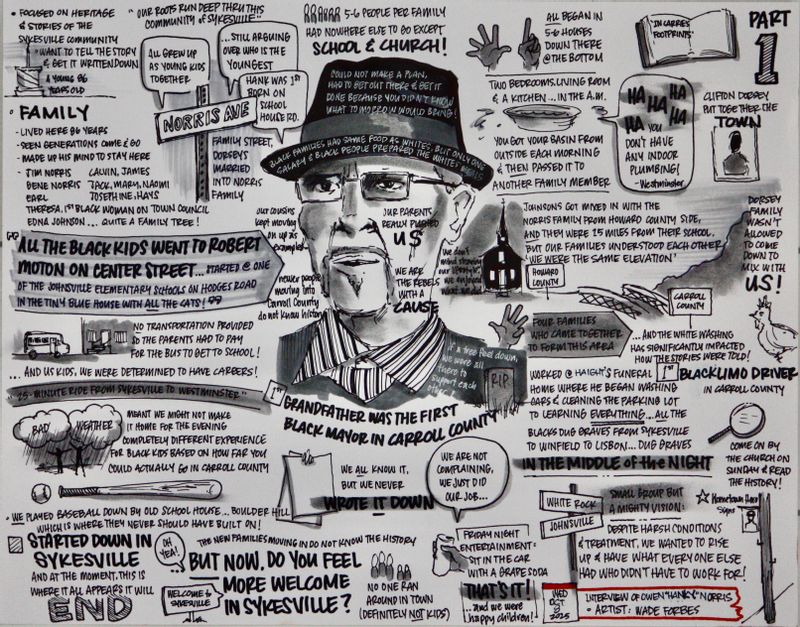
“Well, I’m 86 and I’ve been here all my life. And I’ve seen generations come and go. I had made up my mind that I was going to stay around Sykesville area into my retirement. As far as my family’s concerned, I don’t really know how far back they can really go. The census goes back to 18-something, I remember. Jim Norris was the father to Gene and Earl and Theresa was married into the family, along with Edna Johnson who also married into the family. And the family just grew from there. As far as my lifetime, I’ve been here all my life. “Is Norris Avenue named for your family?
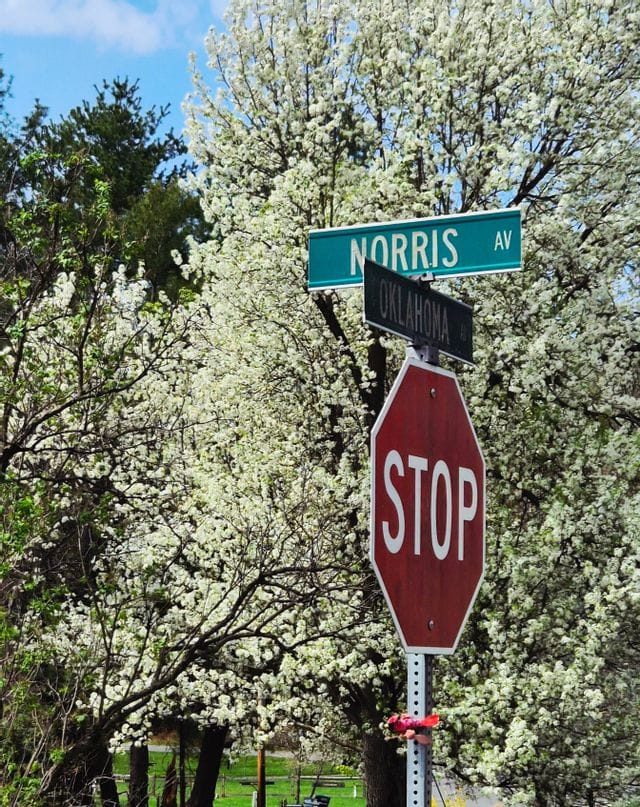
“Yes, Norris Avenue is named for my family. It was always known as Norris Avenue but it was never pushed as it is now – it was just another street. As the family grew older, the street became more popular with more younger people [moving] on the street. Of course, there was Eugene, myself, Calvin, James – we’re all in one family but they never moved up from this one street. The whole area was considered the “Norris/Johnson area.”
Oh wow. So it was all referred to as family areas… the Dorseys have a big family here too, right?
“Well, the Dorseys married into the Norris family. And it was just “boom” – grew from there. The Dorseys had kids, the Norrises had kids, the Johnsons had kids, and all of those kids were out of that same area [in Sykesville]. It wasn’t that we were split up between this area and that area…we all grew up in the same area, and as brothers and sisters. (Discussion with family) “Hanky was the first to be born at Schoolhouse Road…”. “Mmm hmm, that’s right.”
How has your family been connected to downtown, local businesses, schools, or churches?
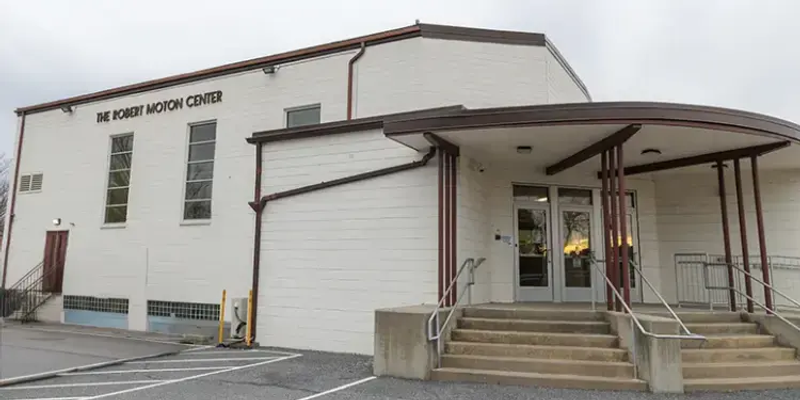
“Well where I come from, and where I’d been – we all wound up together at Robert Moton High School. That’s where all the black kids went to school. You know you didn’t have 4 or 5 schools to go to. The schoolhouse is where I was born and raised, and then I went to Johnsville Elementary (formerly off of Hodges Road). All the Black kids growing up before high school that’s where we went, and then as we grew older we all went to Robert Moton. Back in the day you didn’t have a whole lot of Black transportation – very very little Black educational transportation. But we were determined to make it to high school, as it was a great career that depended on where you wanted to go with it. We weren’t gonna stop until we made it to high school. We used to ride a bus from Sykesville train station to Robert Moton school. Our parents had to afford the bus because the Board of Education wouldn’t give us any kind of transportation. Then we left there and that’s when they built the new Robert Moton (elementary school). And from there is where we’re at now. Now we’re trying to get a museum built [about the former Robert Moton High School] because that would be the only recognition of the Black children of Carroll County. It is important for people to pursue this, because in the case of Robert Moton HS, most of us are dead and gone. The point is, how much help can you get from the community that furnished that school? Mt. Airy…Winfield…all those houses back in those little dirt roads furnished that school bus for us, which went from one end of the county to the other. A 25-minute ride from Sykesville to Westminster on a good day. Sometimes on a bad day, we would get out of school at 3:30 and not be home until 5 o’clock in the afternoon. There was no place else to go and you only had one bus going to Sykesville. There was another bus going to Mt. Airy and Winfield. Mr. Lee drove that one. I don’t think there was too many kids who missed the bus back in the day, ‘cause if you knew you missed the bus you were home for the day. And when mom and dad came home and you were home they wanted to know why you were there (chuckle). So it was an experience of living in Carroll County for Black kids.”
The Robert Moton High School Museum
How about you, where did you spend most of your working life?
“After high school I worked construction for awhile and then got a job at the Haight funeral home. I went there to wash cars, clean the parking lot, keep the cars clean and I wound up learning everything that the place offered. They never stopped me from going into the business. I went from a car washer into a dresser to driving a limousine. I was the first black limousine driver in Carroll County. You would never know it by looking at the history in Carroll County, though.”What role has the town played in your family’s story?
Growing up, what was it like for the Black community in Sykesville through segregation and integration?
“It was an experience where you would become dominated by how far you could go or how far you couldn’t go in Carroll County. Of course, we learned to live with it because we didn’t have anything else to survive on and enjoy life with. On Saturdays and Sunday evenings we played baseball, down where the Black community is in Sykesville now – that was our favorite ball time. We had one church, that was St. Luke’s Church. Then we went from there to Johnsville, where the other part of the Black community added together. Black families lived five or six in a family, and there was no other place to go but to church, and back home. But we enjoyed what we did, because you had to enjoy it in order to do it.
On the Howard County side (of the bridge), that’s where the Johnsons lived. Their school was about 15 miles from the church. That’s how the Johnsons got mixed in with the Norrises. There was no transportation, my mother and father walked to school every day. My mother’s family lived on one side of the bridge, and my father’s family lived on the other. Once you drew them all together, you had a pretty good crowd! Everything grew out of schoolhouse road!” (Discussion with Robbinette): where you used to play ball at is now called Boulder Hill, right up schoolhouse road and down Oklahoma and leads you to the ballfield”. “It was more true than false – the Dorseys lived on the top of the hill and weren’t allowed to come down to play ball with us, and they would sit up there and watch us play ball in the ballfield (chuckles). But eventually we integrated among the families and grew our community to be a large one, despite the locations up, down and across the bridge.”
Were there places or events in town where you felt unwelcome or excluded?
“You know, really the big problem was the Robert Moton schooling (the fact that there was only one school for black kids in Carroll County). (Discussion with family): “many Black citizens had to go to the back of the bar, in one of the two former bars that were right next to the bridge over the Patapsco River prior to the flood, or they were made to go around to the side door, never the front door because they were considered ‘different’.” “You didn’t see black kids running around in the street in Sykesville – you weren’t allowed to go into stores on Friday evenings with your mother and father. You didn’t run around town without your parents, and you never saw kids hanging out in the town.”
What are some of your earliest memories of Sykesville?
“We all survived in these little houses – because most of them only had 2 bedrooms, with 5 and 6 kids among the families. Our house had 2 bedrooms, a living room and a kitchen, that’s it. So you got up in the morning, went out, got your little basin full of water, washed up, threw it away and got the basin for the next person. And that’s the way we lived - we didn’t have indoor plumbing. Sometimes this was a basis for prejudice within the kids at Robert Moton – those in Westminster that had indoor plumbing and those in Sykesville that did not.
Where St. Lukes church is now, (he learned from his parents/grandparents) there was a tornado or something that came through and washed away everything - all that land out in front of that church [referring to the Sykesville flood of 1868]. That’s how it got split like it was [the land] and the entrance to the church was off of a different road that isn’t there now. (Discussion with family): we remember how difficult it was to get up the original road to church. You’d be all dressed up in your best clothes and having to push cars up the hill or walk through the rocks and mud just to get to church.”
Do you feel Sykesville has changed over the years in terms of inclusion and welcome?
“Oh yeah. Though I can’t say I feel any more welcome, specifically - but if you came up back in the early 30’s - it would have been a whole lot easier today. Young Black kids didn’t get to go to town on their own.” (Discussion with Robbinette): “as a Black kid your entertainment on Friday night would be to sit in the car on Main Street, with a grape or orange soda. We didn’t do anything but sit in the car on main street and we would get a pop and then we would go home. There was nowhere else for us to go.”
What do you want people to remember about the Black experience in Sykesville—both the challenges and the contributions?
“We want everybody to know that Sykesville has a very rich history of the four or five black families that were established here. Our heritage, our roots run deep through the town - it was not written down in the way it should be – you can look back a hundred years and never know that these families, that we were here.” (Discussion with Robbinette): “take for example those family members that were highlighted in the Black History Month banner – many of today’s generations don’t know who they are. We are hoping that highlights like these will be a step in the direction to change that. Spark conversations, get the history down. This year we will have some black faces as Hometown heroes.” “It just takes one person to spark the conversations and for the rest of us to respond in kind.”
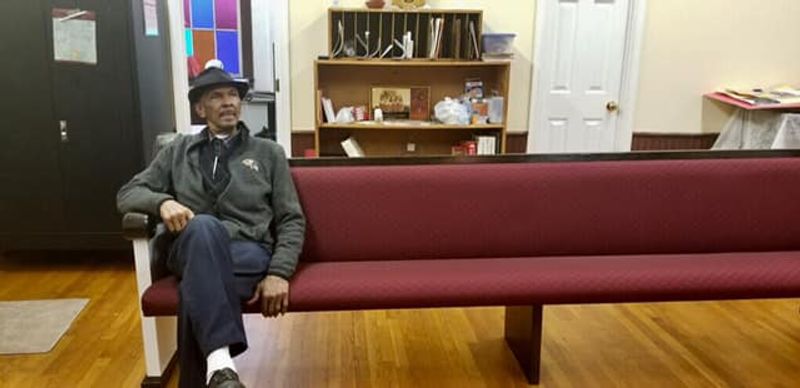
“Hankie” Norris at St. Luke United Methodist Church - Sykesville,MD
What do you hope younger generations will take away from your story or your family’s story?
“I’d like them to at least think about where we came from. Five little houses ‘down in the bottom’ and the Dorseys lived along the top ridge of Sykesville, you either lived ‘on the top’ or ‘on the bottom’ [of Oklahoma Road area in the town]. But we all went to the same schools, we all went to the same churches. It’s important to realize this is where we, as the Black community, started from. Hopefully we’ll be able to highlight more of the history and more people will become interested in how we survived and thrived. We did it because we were determined to be something, to have everything that everyone else could have.”
--
Owen “Hanky” Norris was, among many things, a hardworking man of the community. Graduating from Robert Moton High School, he worked with over three generations of the Haight family at Haight Funeral Home & Chapel, Sykesville where he retired after more than 30 years of service as a funeral assistant, while at the same time also working for Carroll County Public School System as an evening shift custodian at Carrolltowne Elementary School. Hanky was a lifelong member of St. Luke's United Methodist Church, Sykesville, a member of the Former Students of Robert Moton, and he remained as caretaker of St. Luke's Cemetery until his passing. As I left on the day of our interview, I promised him that I would bring light to his story and to the important legacy of these Black families who are the cornerstone of Sykesville – even if it was never written down in the first place. To say that I feel lucky to have heard his stories is an understatement, and I hope in time we can continue to see his dream of capturing this crucial history of our town fulfilled.